


A Warning of Things to Come


On February 9, 2020, less than a year into his presidency, Nayib Bukele ordered heavily-armed police and soldiers to take over the National Assembly building in an attempt to coerce lawmakers into approving a $109 million loan to purchase police and security equipment. In a strange display of autocratic narcissism, Bukele sat at the head of the legislature, and in front of the cameras of the world, wept and prayed. During an orchestrated rally with thousands of his followers outside of the National Assembly building that same day, Bukele would claim, “I asked god, and god told me, ‘Patience.”
First Steps Toward Dictatorship
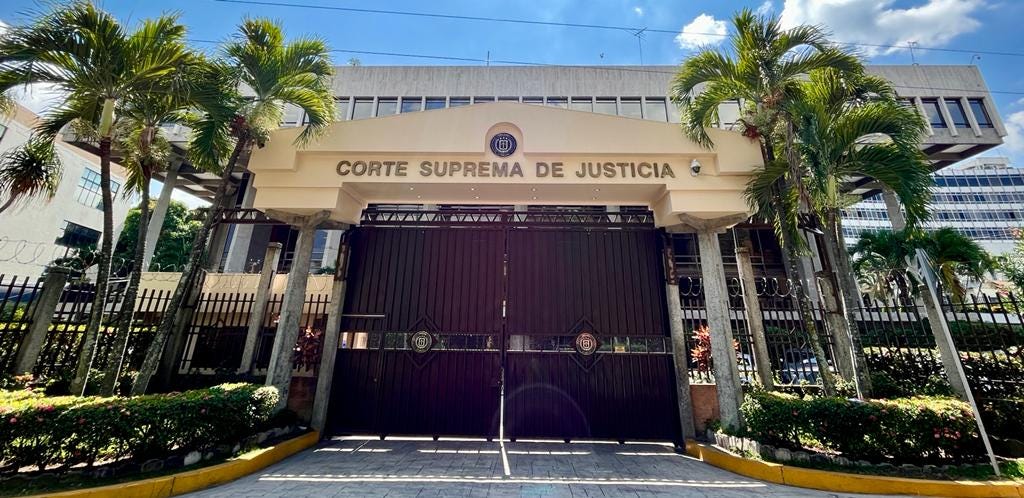
February 2021 - National Assembly elections give Bukele’s party, Nuevas Ideas, along with other right-wing allies two-thirds majority status, allowing them to make sweeping changes to legislature.
May 2021 - The Bukele-dominated National Assembly orders the removal of El Salvador’s attorney general and ALL FIVE justices from the country’s Constitutional Chamber of the Supreme Court. They were replaced by judges loyal to Bukele.
September 2021 - El Salvador’s Supreme Court rules that Nayib Bukele can serve two consecutive terms as president, despite it being explicitly prohibited by the Salvadoran Constitution.
Making Up Loopholes
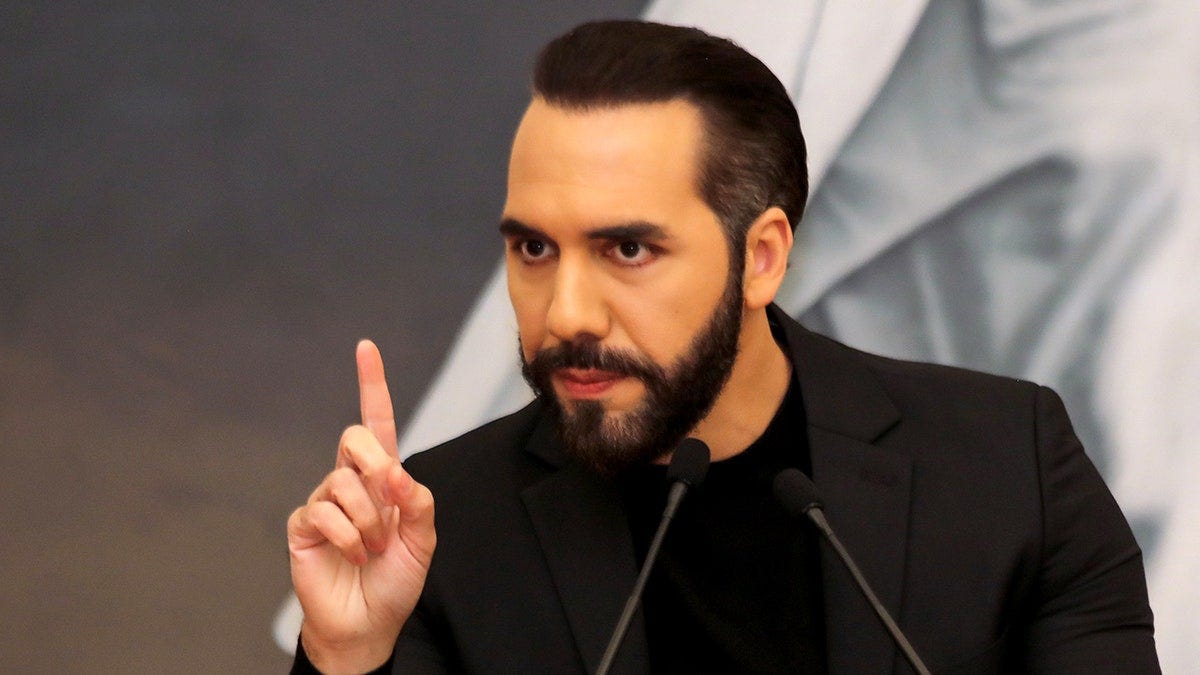
September 2021 - Despite the Salvadoran Constitution explicitly prohibiting a president serving two consecutive terms, Bukele’s new judges figured a “loophole,” or more accurately, they made one up. According to Article 152 of the Salvadoran Constitution, a person cannot be a presidential candidate if they have served as president “more than 6 months, consecutively or not, during the period immediately before, or during the last 6 months before the beginning of the presidential period.”
The judges interpreted this clause to mean, that as long as Bukele vacated the presidency 6 months prior to the start of, his still theoretical second term in June 2024, he would be able to run for a second consecutive term.
Consolidation of Power


For much of its post-Civil War history, the Salvadoran National Assembly was composed of 84 deputies representing 262 municipalities. In June of 2023, the National Assembly approved a restructuring of the voting districts by reducing municipalities from 262 to 44, and the number of elected deputies from 84 down to 60.
The new and reorganized National Assembly would give Bukele’s party, Nuevas Ideas, total control of El Salvador’s legislative branch and the power to pass any laws the regime pleases.
The State of Exception
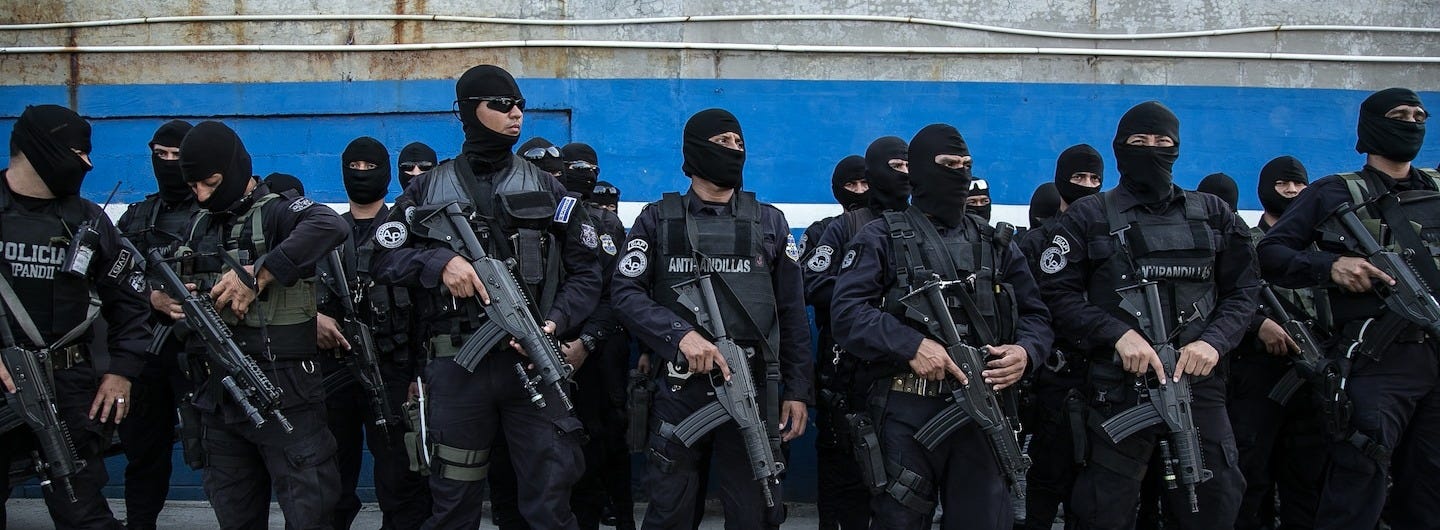
A breakdown in negotiations between the Bukele regime and criminal organizations resulted in a sudden spike in homicides in late March 2022. The Bukele-controlled National Assembly capitalized on the situation and declared a state of emergency called State of Exception (Régimen de Excepción).
“In the event of war, invasion by a foreign entity, rebellion, sedition, catastrophe, epidemic, or other general calamity or grave disturbance to public order,” (Article 29, Item 1) the State can suspend certain basic freedoms such as speech and assembly, however, as it pertains to due process, the State of Exception suspends the following constitutional guarantees:
“A detained person must be informed in an immediate and comprehensible manner, their legal rights and reason(s) for their detention… the detainee is guaranteed the assistance of a legal defender.” (Article 12, Item 2)
“The administrative detention shall not exceed 72 hours, during which the detainee shall appear before a judge.” (Article 13, Item 2)
The State of Exception cannot exceed 30 days, unless extended by decree of the National Assembly. As of today, the State of Exception has been renewed 40+ times and has now been in effect for more than three years.
New Draconian Laws
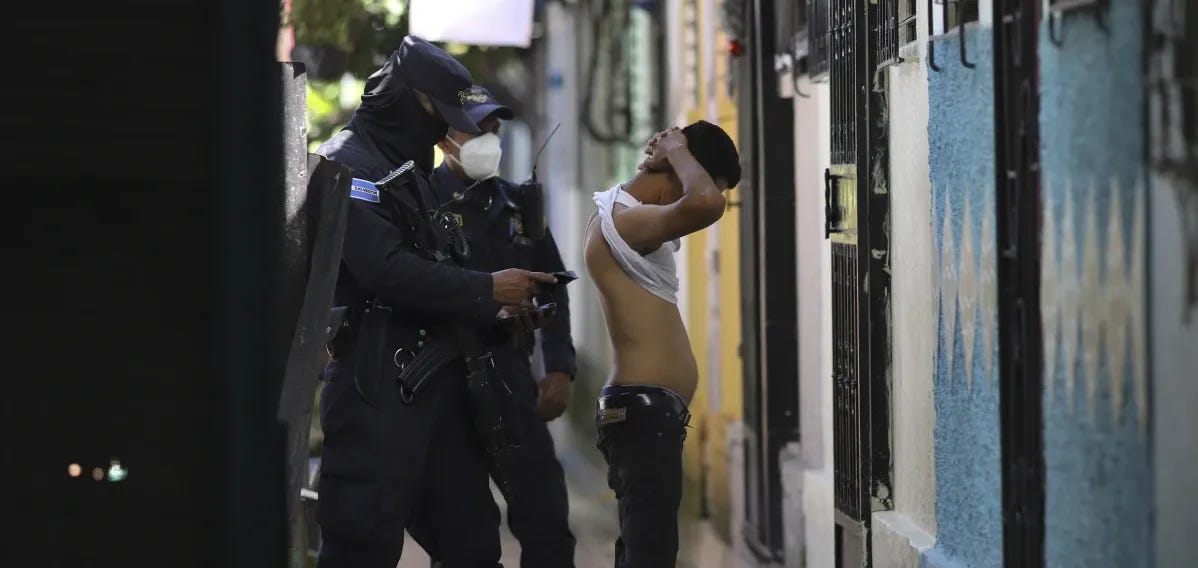
With the passage of State of Exception in late March 2022, the Bukele regime also took the advantage of the state of national emergency to pass new and harsher penalties for gang activity as well as laws that further eroded basic freedoms:
Lowered criminal responsibility of children involved in gang activity from 16-years, down to 12-years-old.
Allowed prison sentences of up to 10 years for children ages 12 to 16 and up to 20 years for children over 16.
Convicted leaders of a “terrorist” gang could face 40 to 45 years in prison, previously it was 14 years.
Membership in these groups now carried a sentence of 20 to 30 years, up from 3 to 5 years.
Criminalized the creation of any type of publication, image, graffiti or other form of visual expression that “explicitly or implicitly” transmits “messages” about or that “alludes to” the various types of gangs. The penalty is up to 15 years in prison.
Criminalized media outlets that “reproduce or transmit messages or statements created or allegedly created” by gangs that “could generate a state of anxiety and panic to the population in general.”
The Human Cost of the State of Exception
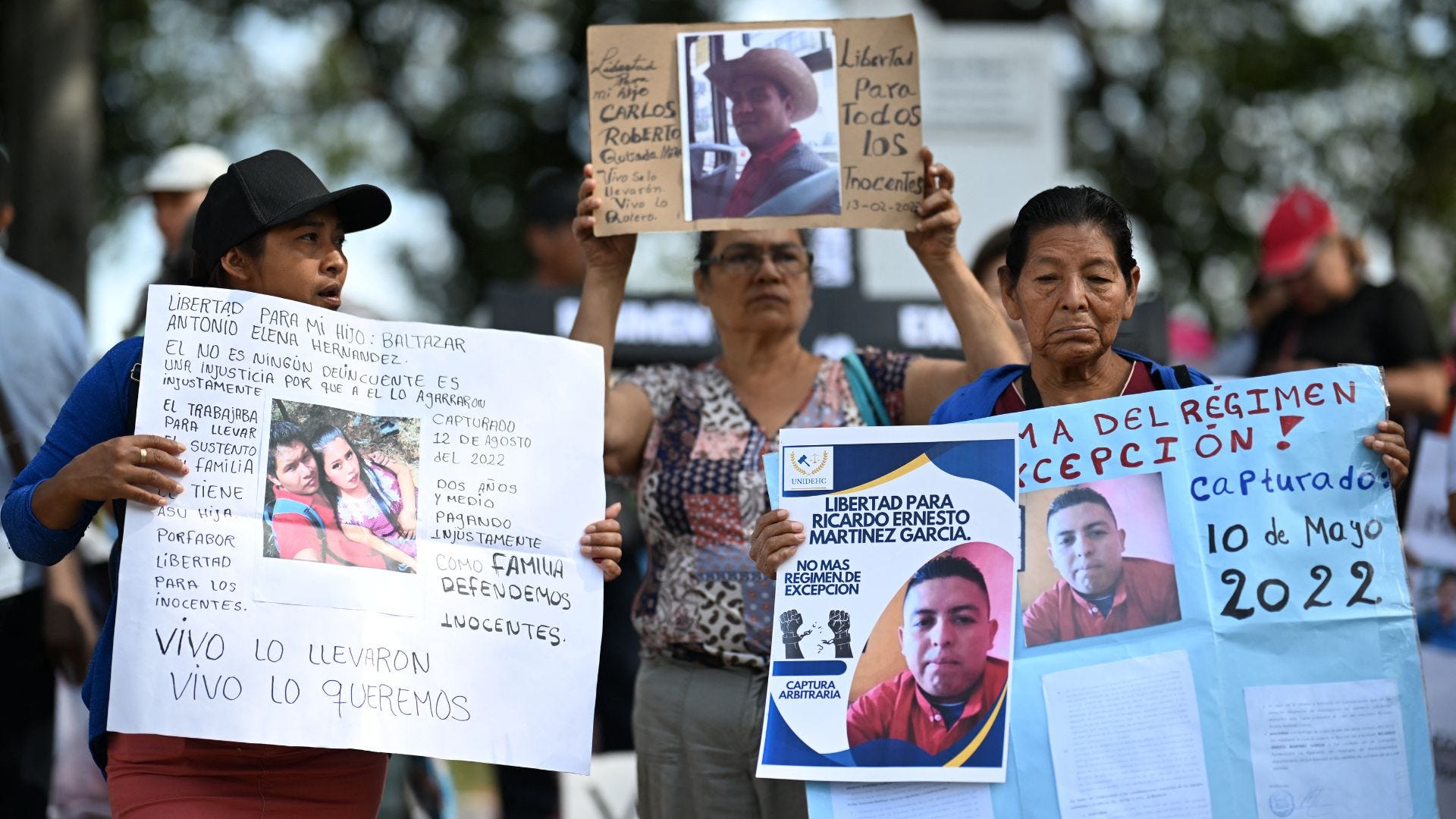
Since March 2022, at least 85,000 Salvadoran citizens have been arbitrarily arrested; as of February 2026, the majority remain imprisoned without any actual charges in a state of judicial limbo. Only around 8,000 detainees have actually been released for lack of evidence of any wrongdoing.
Around 2% of the adult population of El Salvador is incarcerated. El Salvador now has one of the leading incarceration rates in the world, ahead of the United States which has a population ~52 times larger.
Hundreds of documented arbitrary arrests; forced disappearances; wide usage of torture on detainees have been reported to human rights organizations.
Tens-of-thousands of detainees have remained imprisoned for 1-2 years, awaiting processing without access to legal representation, or contact with the outside world.
As of May 2025, at least 378 people have died in custody of the authorities. The actual number is believed to be over 1,000.
More than 3,300 children have been arrested, some as young as 12-13 years old.
Nearly 40,00 Salvadorans have been arrested on the nebulous charge of “unlawful association;” less than 1% were arrested for actual violent crimes.
The Abusive Powers of the Salvadoran State
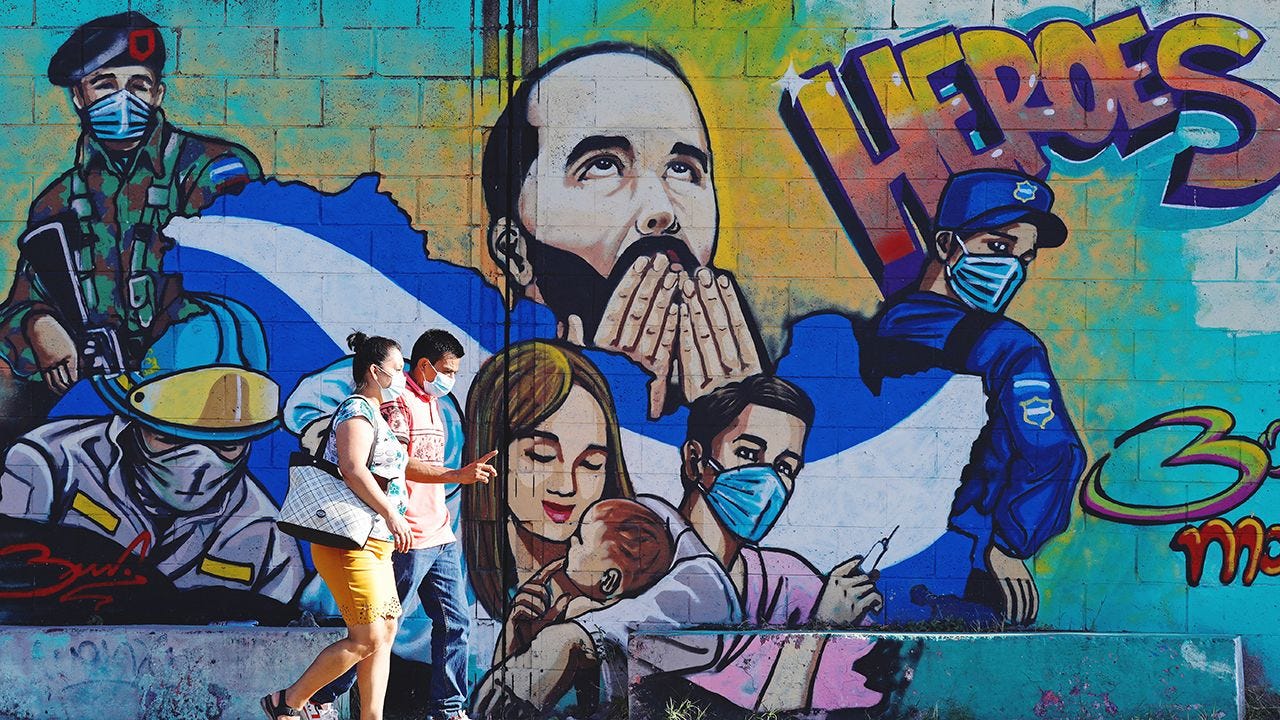
The authorities can detain and arrest a Salvadoran citizen based SOLELY at the discretion (or whim) of the police officer. Most people are arrested on the nebulous suspicion of “illicit association” to gangs or criminal organizations. No evidence is required.
The authorities do not have any obligation to guarantee detainees ANY access to legal representation.
The authorities can arrest and detain any citizen for more than 72 hours without demonstrating cause or formally appearing before a judge. Given the tens-of-thousands of people in the system, the processing time can last months. Some detainees have been imprisoned for more than two years.
The authorities can violate the privacy of correspondence and telecommunications without a court order.
The authorities can arrest anyone without a court order and can re-arrest anyone EVEN if they have a cleared criminal record.
The authorities can conduct mass trials wherein defendants can be charged and sentenced simultaneously for a single crime in groups as large as 900.
The Salvadoran Prison Industrial Complex
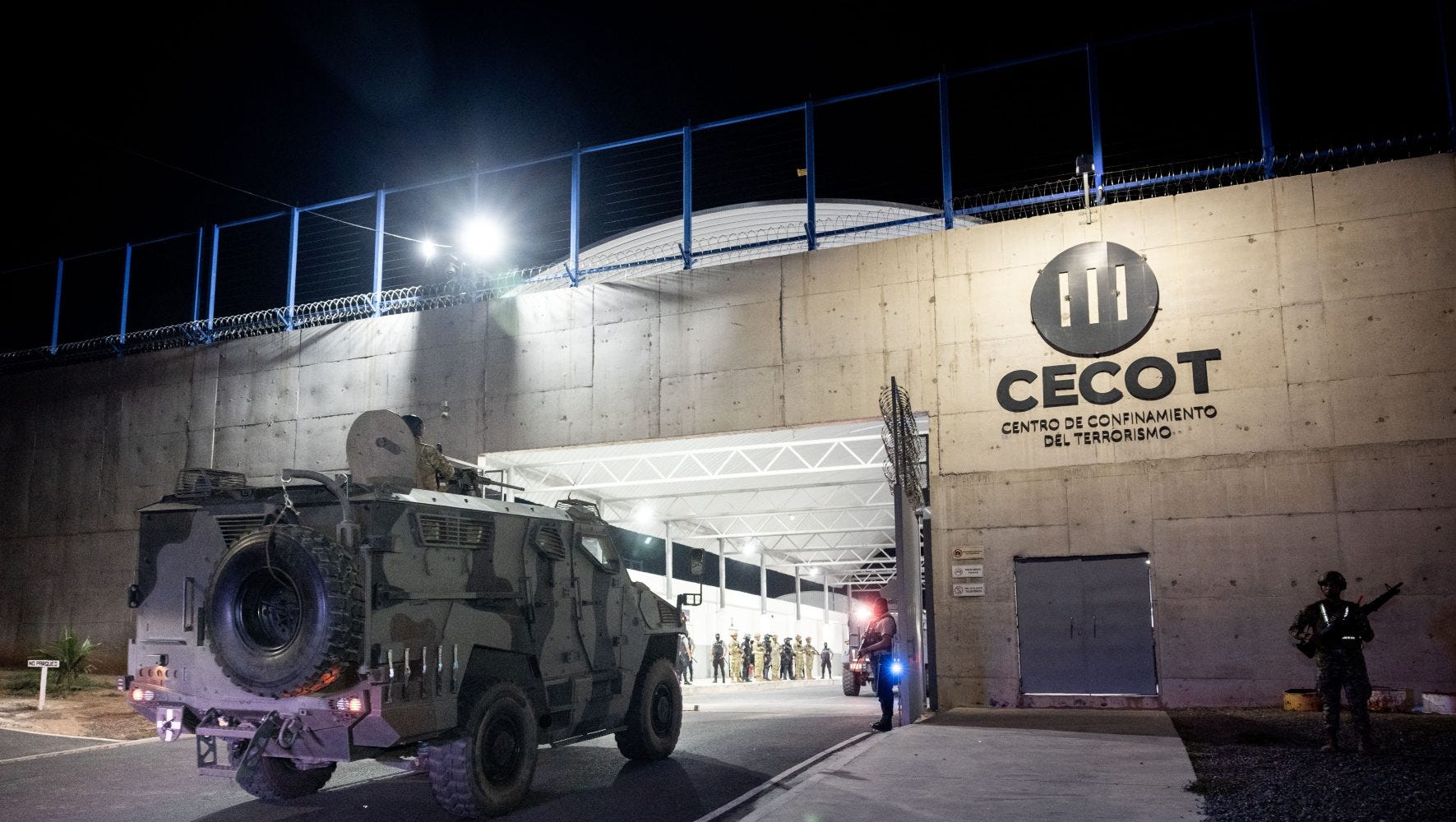
Despite the recent worldwide notoriety that the Center for the Containment of Terrorism (CECOT) has garnered, this Salvadoran mega-prison is in fact a clean and modern “display prison” where the Bukele regime routinely parades alleged gang members for journalists, social media influencers, and Republican officials.
Other prisons like Izalco and Mariona, which are inaccessible to journalists, are where the remainder of the 85,000+ Salvadoran citizens arrested under the State of Exception are incarcerated, including women, elders, and children. These prisons have hundreds of documented cases of abuse and poor conditions:
Massive overcrowding; 109,000 people are held in a prison system with a 70,000 capacity.
Overcrowding has led to inadequate food, poor hygiene, and improper sanitation; some detainees are forced to sleep standing.
Detainees are routinely subjected to beatings, torture, sexual assault by BOTH prison guards and other detainees.
Chronically ill detainees are denied basic health care. Many have died as a result of gross neglect.
The Destruction of the Salvadoran Family
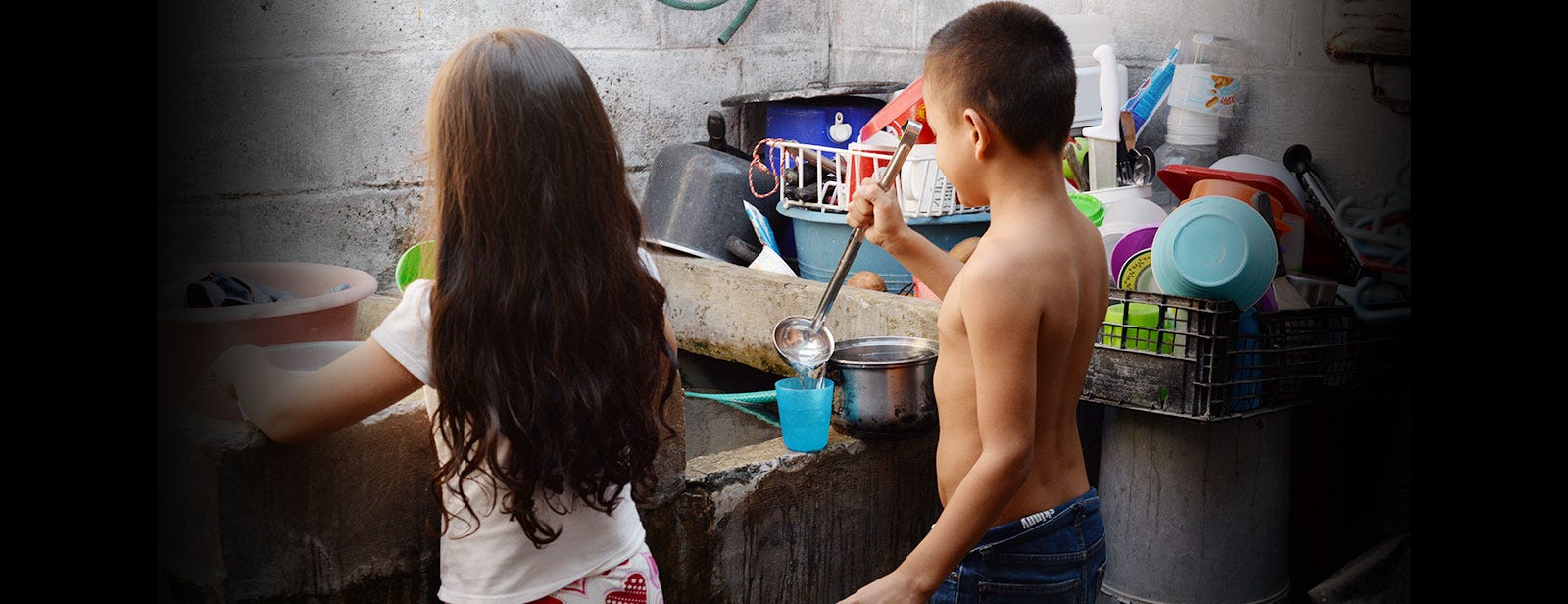
More than 100,000 Salvadoran children and adolescents have been abruptly separated from a parent as a result of the State of Exception.
The lack of information on the whereabouts and condition of incarcerated loved ones has resulted in increased levels of anxiety, depression, and other mental health issues among tens-of-thousands of affected families.
Despite the resulting mental health crisis among Salvadoran children and youth, the Salvadoran government has not adequately responded to provide them with care or resources.
The loss of one of more providers has also created greater economic strain on affected families, leaving the remaining parent and/or other family members to carry the burden of maintaining the household.
Families have to spend between $80-$100 on weekly packets of food and hygiene products for incarcerated loved ones, despite not even knowing if they are still alive. Average salary in El Salvador is ~$365 per month.
Bukele regime’s poor economic planning and policies have resulted in rising costs for basic food and necessities, and has contributed to an increase of extreme poverty throughout El Salvador.
The Bukele regime’s securitization of El Salvador coupled with detrimental economic policies have not only heightened and perpetuated cycles of poverty and the destruction of family units, but are contributing to an eventual return of rampant criminality.
Trump & Bukele: Fascist Allies
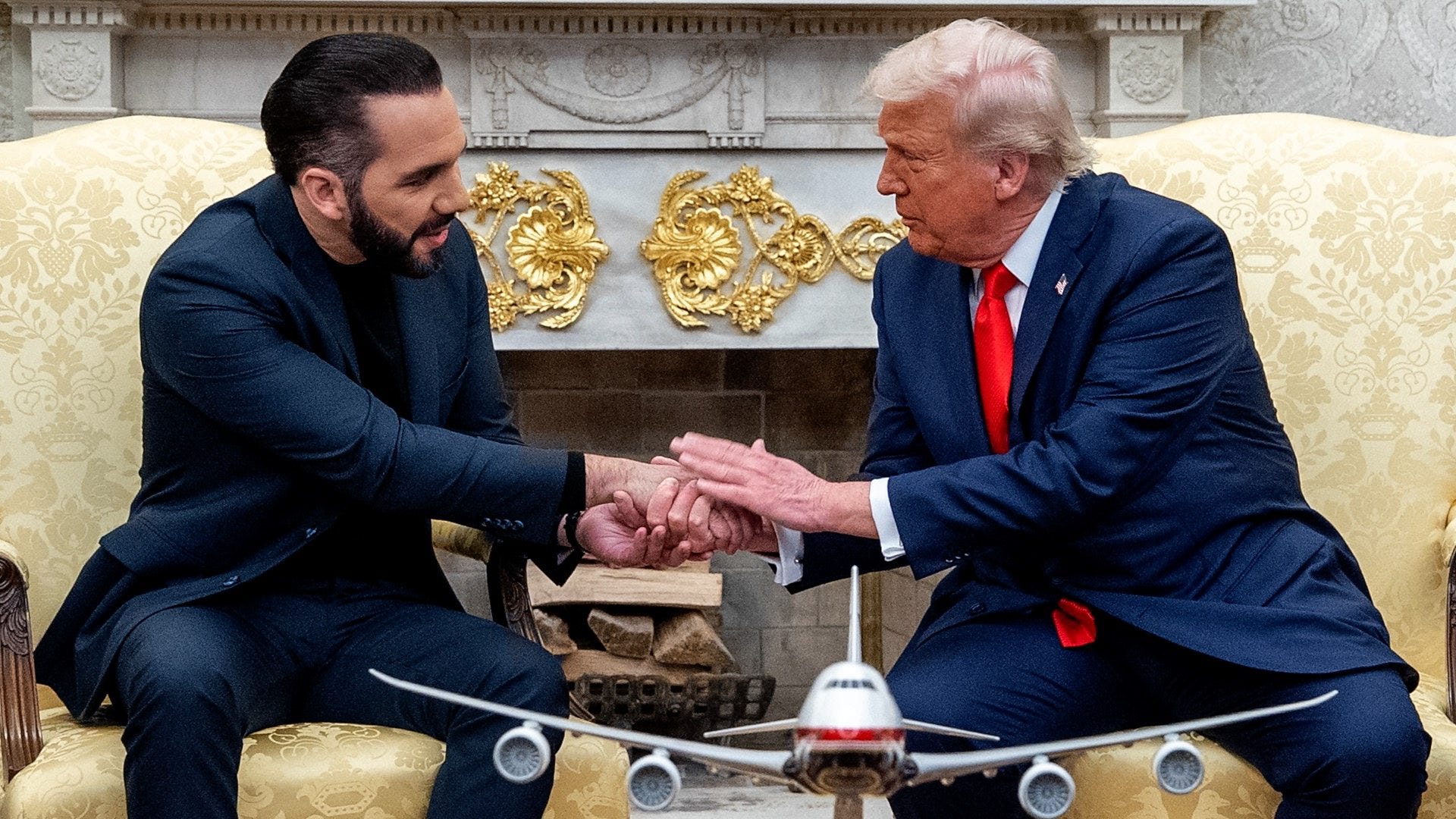
Fascism relies on the dehumanization/ demonization of marginalized populations to justify and rationalize its operations of violence.
The intensification of repression against migrants by the current Trump administration could not have been possible without the first Trump administration (2016-2020) having weaponized the imagery of brown, tattooed bodies of MS-13 gang members to construct a vocabulary of fear and hate for his right-wing base, which through osmosis filtered out into the larger cultural imaginary of the United States.
Likewise, the escalation of violence and mass incarceration of 85,000+ Salvadorans under the State of Exception would not have been possible without a vicious campaign of dehumanization and criminalization of El Salvador’s poor and working-class by the Bukele regime.
Both Donald Trump and Nayib Bukele are utilizing the same fascist playbook: to criminalize marginalized populations and keep everyone distracted with spectacle, terror, and outrage, while in the background they dismantle democratic checks and balances and consolidate power.
President for Life
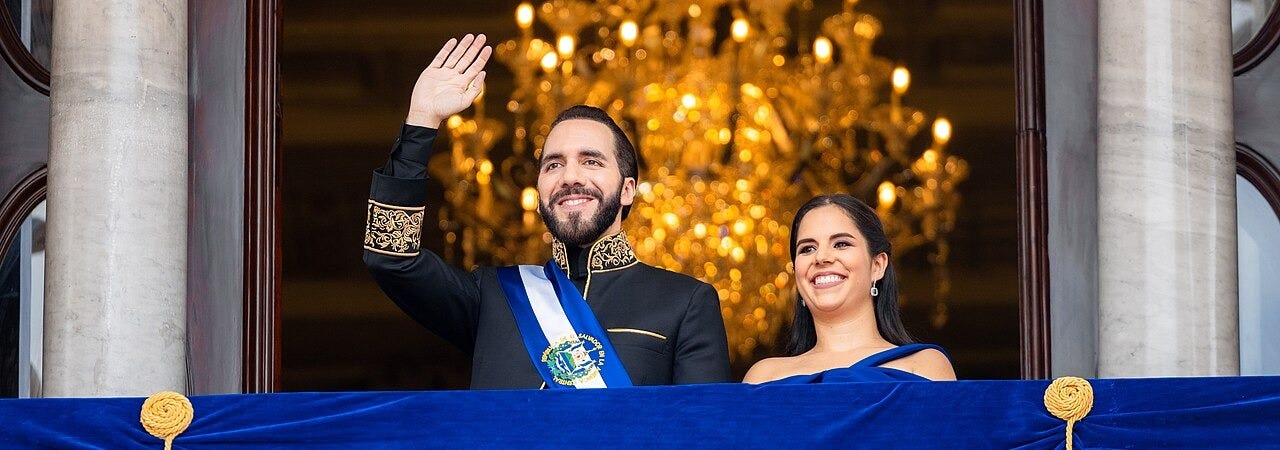
November 2023 - The National Assembly, controlled entirely by Nayib Bukele’s Nuevas Ideas party, approved Bukele to step down as president and take a 6-month leave “to allow him to campaign for re-election.
February 2024 - Nayib Bukele was unconstitutionally re-elected for a second term.
April 2024 - The National Assembly approved a reform to the Salvadoran constution that would allow changes to be made to made to the constitution with no waiting period and only 45/60 votes. A full 57/60 assembly members are aligned with Bukele.
July 2025 - The Salvadoran National Assembly, proposed new changes to the articles of the Salvadoran constitution. These included allowing indefinite presidential re-elections and extending the presidential term from 5 to 6 years. The bill passed 57-3 in favor.