


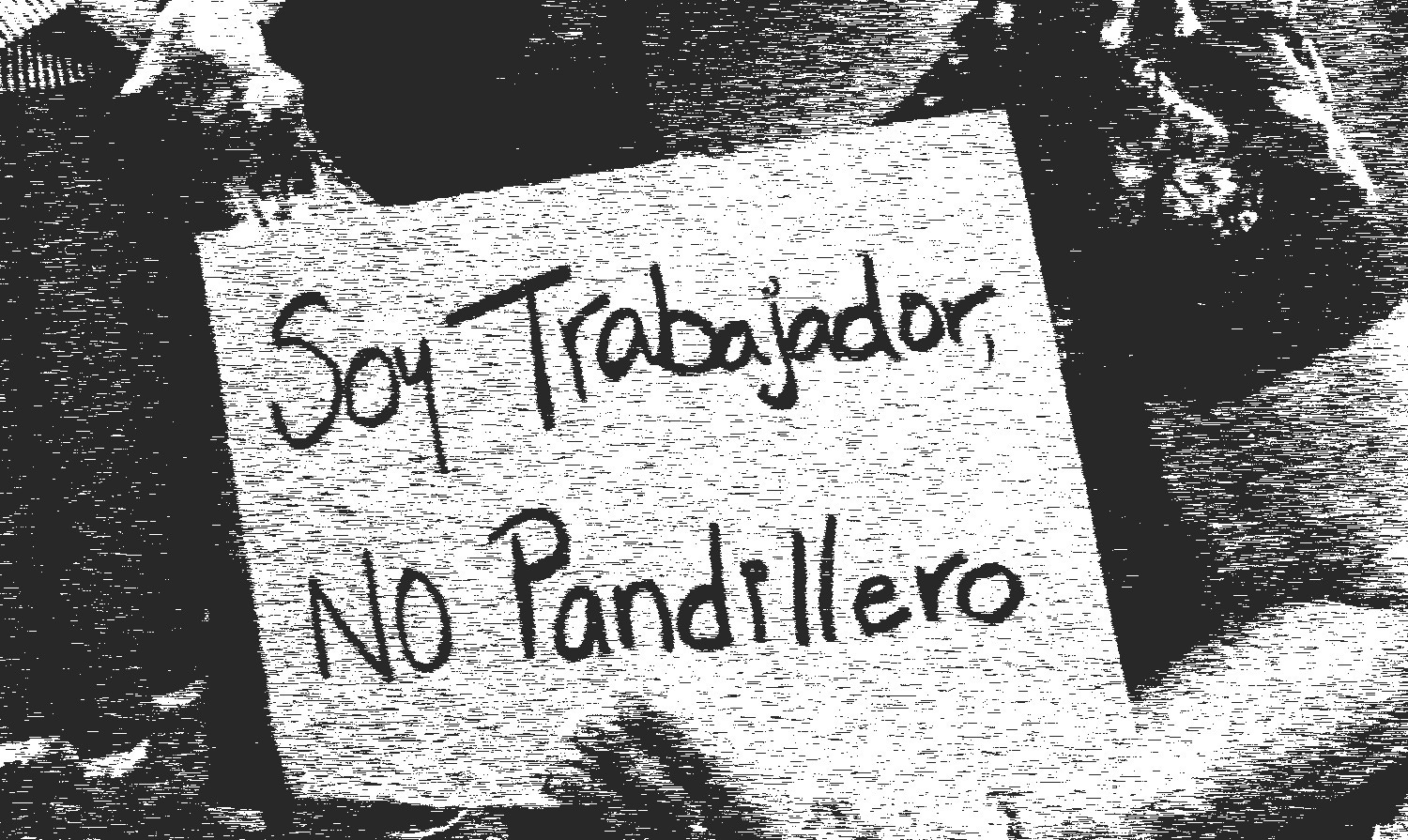

The majority of the 70,000+ Salvadoran citizens who have been imprisoned as a result of the State of Exception were arrested on the suspicion of “illicit association.” (agrupación ilícita). According to Article 345 of the Salvadoran Penal Code, there are four criteria the state needs to prove:
1) that the suspect is a member of an illicit [forbidden by law] grouping, association, or organization; 2) that the grouping consists of two or more people and have some degree of organization; 3) that the objective (or one of the objectives) of the group is the commission of a crime; and 4) that the group performs violent acts or utilizes violent means for the induction, permanence, or departure of its members.
On paper, the law provides specific characteristics for what constitutes a criminal organization, that is to say, simply “belonging” to a gang is not a criminal offense. However, being a member of an organized group while committing (or having the intent to commit) a violent crime is how the law defines a gang. In practice, however, Salvadoran police have taken creative liberty in interpreting the “illicit association” law and have routinely demonstrated their own self-entitled authority and discretion to arrest any citizen on the mere suspicion of being a member or collaborator of an illicit group, which unfortunately in some cases includes the families of gang members and even the victims of gang extortion.”

Bear in mind that prior to the implementation of the State of Exception in March 2022, the Salvadoran government was already engaged in heavy-handed policing against gangs. But at the very least, any Salvadoran citizen arrested under the suspicion of illicit association would, per the nation’s constitution, have to be formally charged before a judge and then given a fair trial with legal representation where the State would have the burden to prove that the defendant met all the criteria for the crime of illicit association.
Because the State of Exception has in effect suspended due process, including the right to legal representation and the right to timely judicial processing, at the moment, any Salvadoran citizen is subject to arrest based entirely on the biased opinion and at the discretion of any given police officer or a third-party’s accusation; and said citizen could spend years incarcerated waiting just to be made aware of the charges against them. As the Director of the Salvadoran National Civil Police Stated in a press conference in February 2023, “A police officer is a judge on the streets…”

The Bukele regime is also facing a public relations problem. To date, Nayib Bukele’s greatest achievement in office has been the reduction of homicides and the alleged dismantling of all gang organizations via the State of Exception, and which has privileged the Bukele regime with widespread public support. Despite the regime having assured the public that every single individual arrested under the State of Exceptions was indeed a vicious gang member, or associated with gangs, government officials likely have knowledge that thousands of arrested citizens in reality never had ANY ties to gangs or any related criminal activity.
But the Bukele regime cannot simply release tens-of-thousands of unjustly arrested and incarcerated citizens. Doing so would not only place the regime in the vulnerable position of having to admit that it committed a grave miscarriage of justice, but it would also undermine the entire rationale and justification for the State of Exception. And especially with the upcoming 2024 presidential elections, Nayib Bukele needs to continue banging drums for his War on Gangs and keep the population fixated on the topic of security, and NOT on the pressing issue of the economy. As Bukele stated in a speech from May 2023 “we will crush these damned murderers and their collaborators, we will put them in prison and they will NEVER get out.”

In a round-table discussion hosted by state-controlled Canal 10 on the first anniversary of the State of Exception (March 27, 2023), attorney general Rodolfo Delgado, spoke about the government’s appalling end-goal strategy for the 70,000+ detainees still waiting to have their day in court. According to Delgado, the implementation of State of Exception served as the first stage from which new and extremely punitive reforms to existing law would stem:
HARSHER SENTENCES - In March 2022, the National Assembly passed reforms to the penal code that increased sentences for membership in a gang from the previous 5-8 years to 20-30 years; and for alleged leadership of gangs, from 14 years to 40-45 years. Additionally, prison sentences for children ages 12-16 were increased to 10 years, and for minors over the age of 16, up to 20 years in prison. According to Rodolfo Delgado, “Using all the tools, including the prosecution of minors,… will generate tranquility for the Salvadoran population.”
MASS TRIALS - Due to the unprecedented number of Salvadoran citizens arbitrarily arrested under the State of Exception (70,000+) neither the nation’s prison nor the judicial systems had the capacity to adequately hold and process, respectively, such an enormity of individual defendants. The result was a human rights disaster with thousands of Salvadoran citizens being incarcerated in overcrowded, ill-equipped, and dangerous prisons for months on end without being properly charged.

But rather than release detainees for whom there existed no criminal record, the Salvadoran state began seeking the legal means to prosecute alleged gang members as collective groups, rather than for individually-committed crimes. In July 2023, the National Assembly passed a new bill which would force detainees to remain imprisoned for an additional two (2) years and allow the Salvadoran state to charge and sentence defendants simultaneously for a single crime in groups as large as 900 individuals. The new law even allows individuals from the same region to be tried as a group. Finally, the maximum sentence for leadership of a gang was raised once again, from 45 years, to a maximum of 60 years in prison. Perhaps nothing better embodies the detached and mechanized manner in which the Salvadoran state perpetrates human rights abuses than the following words from bill proposing mass trials, introduced to the National Assembly on July 25, 2023:
“...all this in effect to achieve a greater efficiency in the determination of responsibility of those subjected to judgment…”
NO HOPE OF RELEASE - Echoing the punitive mantra of Nayib Bukele, attorney general Rodolfo Delgado reiterated that any detainee that was sent to the newly-constructed mega prison “would never be let out.” This despite the fact that according to the Salvadoran Constitution, life sentences are prohibited (Article 60) and the Special Law Against Terrorism only allows for a maximum sentence of 60 years in prison (Article 26).

The Bukele regime knows fully well that tens-of-thousands of Salvadoran citizens who have been arrested during the State of Exception under the suspicion of “illicit association” (i.e. being a member of a gang) do not actually meet the criteria for the legal definition of the crime they have been arrested for. Under normal circumstances, without a State of Exception in effect, even with a compromised judicial system, any given defendant arbitrarily arrested and unjustly charged with “illicit association” might stand a chance of being set free since that State would not have sufficient proof to prosecute them. Again, the Bukele regime KNOWS this, which is why with the perpetual State of Exception in place, they pushed the Nuevas Ideas-controlled National Assembly to approve the use of mass trials, giving the state the power to prosecute and sentence thousands of innocent Salvadoran citizens for crimes they neither committed nor had any association to. And with new harsher sentences for gang association in effect, untold numbers of innocent citizens could potentially spend decades in prison.

The State of Exception and rapid incarceration system that the Bukele regime has created will become a permanent fixture, not only as a means of dealing with criminals and other undesirables, but as a symbol of terror against any future popular critique, dissidence, and revolt. As it is, the Bukele regime has already been employing the State of Exception against its political opponents: journalists, academics, labor organizers, environmental defenders, and community leaders. But this newly-minted Salvadoran prison-industrial complex (P.I.C.) will also allow the Bukele regime to deal with another growing issue: mass poverty.
Despite Bukele regime’s high public approval ratings due to its security policies, the lives working-class and poor Salvadorans have not fundamentally improved–in fact, things have gotten worse:
Wasteful mismanagement of public funds.
Growing national debt due to flagrant borrowing from IMF .
No incoming foreign investment.
Lack of attention to root causes of scarcity and poverty.
Mass gentrification dislodging people from traditional forms of employment.
Eviction of families from their lands due to tourism megaprojects.
Unaffordable prices on basic foods.
Thousands of families with at least one provider in prison due to the State of Exception.
As La Prensa Gráfica recently published in July 2023, 1.8 million Salvadorans are presently living in poverty. And given the Bukele regime’s single-mindedness on elevating El Salvador as a global brand through tourism-megaprojects and empty advertising campaigns, economic insecurity will only worsen, leading millions of Salvadoran citizens to seek alternative ways to survive, including criminal activities. And thus, the cycle of criminality and incarceration will begin again.

There is perhaps no better descriptor for the dark road that lays ahead for El Salvador than the following passage from a special report from the human rights organization, Cristosal, marking the one-year anniversary of the State of Exception:
“Massive arbitrary detentions are the entry point to a cycle of terror that includes tortures, cruel, inhumane, and degrading treatment; possible arbitrary deaths; prescribed sentences and trials without any guarantee of due process... the systematic perpetration of these human rights abuses as state policy that is decided at the highest level, of a systematic nature and directed against a specific segment of the population (residents from conflict communities, the poor, and the youth) allows us to categorize them as crimes against humanity.”
Sources:
“El Salvador: Reformas legislativas amenazan derechos fundamentales,” Human Rights Watch.
“Delito de agrupación ilícita será comprobado con la existencia de pandillas, según el fiscal,” El Mundo.
“Informe: Un año bajo el régimen de excepción, una medida permanente de represión y de violaciones a los derechos humanos,” Cristosal.
“El Salvador amplía estado de emergencia por 14ta vez para combatir a pandillas,” AP News.
“¿Cuáles son los cuatro elementos para probar el delito de agrupaciones ilícitas?” Gato Encerrado.
“El Salvador clears way for mass trials as crackdown on gangs ramps up,” The Guardian.
“El Salvador tiene 1.8 millones de pobres, la cifra más alta en cuatro años,” La Prensa Gráfica.
Constitución de la República de El Salvador.
Código Penal, El Salvador.
Dictamen No. 12, Comisión de Seguridad Pública y Combate a la Narcoactividad, 25 julio de 2023.